The same reasoning recurs across a project: “the artefact is ready because all its quality gates pass”. What changes from one release, component, or team to the next is rarely the reasoning itself, but the concrete evidence that backs it.
If you have met the template method in object-oriented design, this will feel familiar: there, you fix the skeleton of an algorithm once and let each subclass supply a few specific steps. A jPipe template does the same for an argument. It captures the reasoning, a conclusion and the strategy that argues it, once, and deliberately leaves holes where the backing will go. Each justification then instantiates the template, filling those holes with its own argument, without disturbing the shared reasoning.
In this tutorial we take the readiness argument you built with
sub-conclusions, factor out its top-level shape into a quality
template, and then rebuild the very same argument by instantiating that template. Nothing about the
conclusion changes; what changes is that the shape is now reusable.
This tutorial assumes you are comfortable with the basics from jPipe 101 and sub-conclusions.
A template is an argument with holes in it
A template looks like a justification, but it can leave positions deliberately unfilled using
an abstract-support placeholder, written @support. Each placeholder marks “some support goes here,
to be provided later”.
Take the readiness argument and keep only its reasoning: the
conclusion, the strategy that argues it, and two holes where the backing will go. That is the
quality template.
template quality {
  conclusion ready is "Version 2.0 is ready to ship"
  strategy gates is "All release gates pass"
  gates supports ready

  @support tested is "Testing is demonstrated"
  tested supports gates

  @support documented is "Documentation is demonstrated"
  documented supports gates
}
The @support keyword marks an abstract support: a placeholder that stands for “some support
belongs here, to be supplied later”. Its label says what kind of backing the argument expects
(Testing is demonstrated), not the concrete fact that will eventually provide it. Like every
support, an abstract one still needs its supports edge, so the template stays a well-formed
argument, just one with two clearly marked gaps.
Those two slots are the whole point: they fix the shape of the argument (a conclusion, argued by a strategy, resting on two obligations) while leaving how each obligation is met open. In the preview they render as dashed boxes:
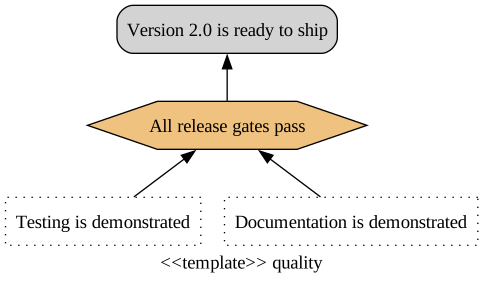
@support is only valid inside a template; a plain justification has no holes.
Instantiating a template with implements
A justification fills a template’s holes by declaring implements <template>. Each abstract support
is a support position like any other, so you can back it however the claim deserves: a single piece
of evidence, or, when the obligation is itself worth arguing, a full sub-conclusion with its
own layered sub-argument.
To rebuild the readiness argument, fill each hole with exactly the sub-argument it had in the
sub-conclusions tutorial: tested becomes the intermediate claim
“the code is tested” argued by its test strategy, and documented becomes “the documentation is
updated”:
justification readiness implements quality {
  sub-conclusion quality:tested is "The code is tested"
  strategy testing is "The test suite passes with high coverage"
  testing supports quality:tested
  evidence suite is "The test suite passes"
  suite supports testing
  evidence coverage is "Coverage is above 80%"
  coverage supports testing

  sub-conclusion quality:documented is "The documentation is updated"
  strategy docs is "The changelog and API docs are current"
  docs supports quality:documented
  evidence changelog is "The changelog is up to date"
  changelog supports docs
}
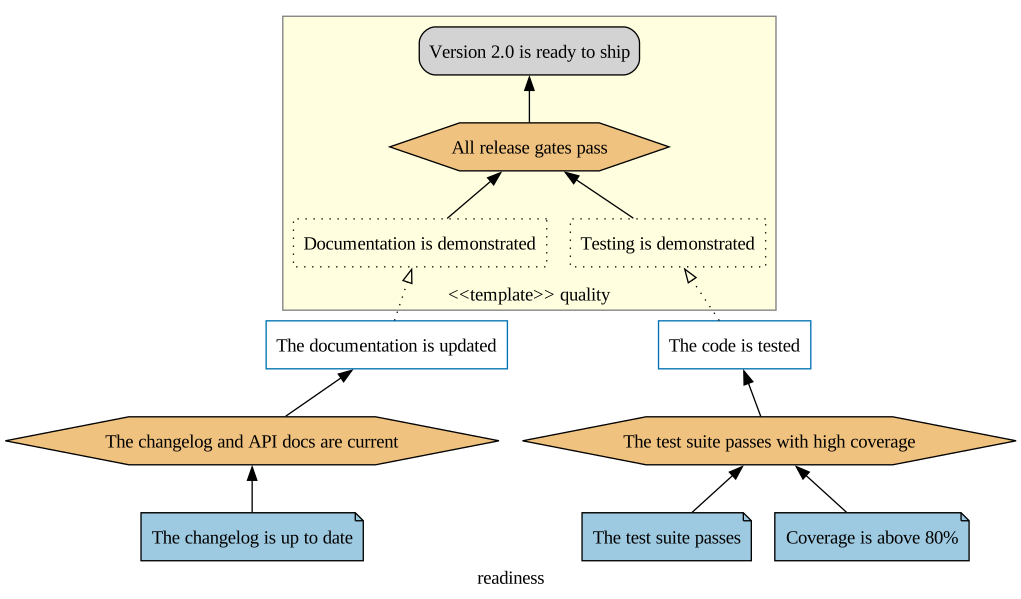
The preview frames the inherited part in a <<template>> quality box, with each hole now expanded
into its own sub-argument. Compare it with the diagram from the sub-conclusions tutorial: it is the
same readiness argument, only its top-level shape is now supplied by the template.
What is inherited, what is declared
Once a justification implements a template, it is not obvious from the source alone which elements it
owns and which it borrows. The IDE’s Outline panel (at the bottom of the Explorer) spells it out:
under readiness it lists every element and tags the ones that come from the template as
(inherited), leaving the ones you declared locally plain.
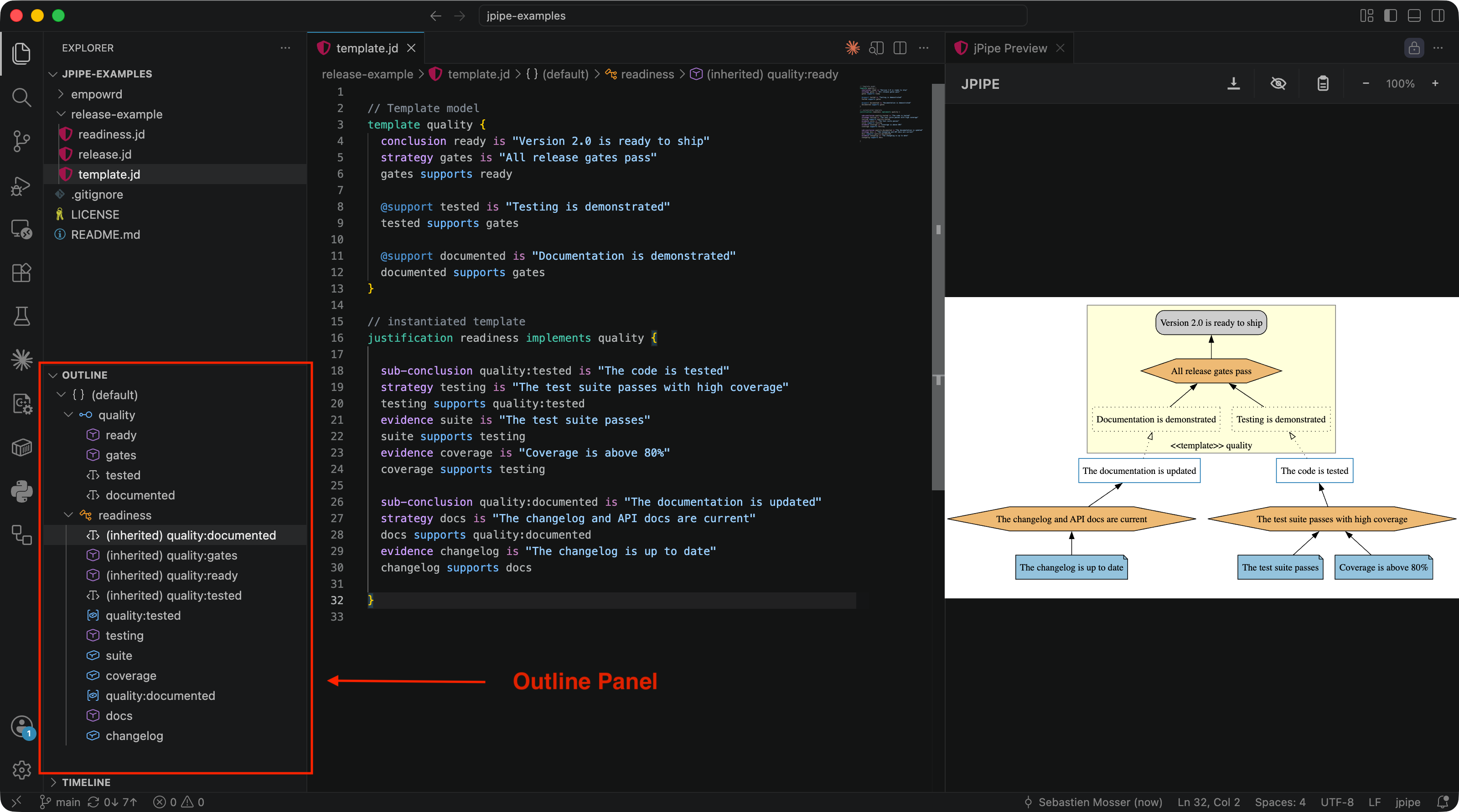
The four inherited entries (quality:ready, quality:gates, quality:tested, quality:documented)
are the template’s conclusion, its strategy, and its two holes. Everything listed below them is what
readiness added to fill those holes.
A note on namespaces
Every element belongs to a namespace named after the template or justification that declares it.
Inside template quality, the strategy written gates is really quality:gates; inside a plain
justification, its elements sit in that justification’s own namespace.
That is why readiness refers to the template’s holes with the qualified id quality:tested: it
is reaching across into the quality namespace to fill an inherited slot. The brand-new elements it
adds for itself (testing, suite, coverage, docs, changelog) live in readiness’s own
namespace, so they need no prefix.
Why templates matter
A template is more than a copy-paste shortcut: it turns an argument’s shape into a contract. Once
your team agrees that every release must argue quality, that one template becomes the standard the
whole project is held to, and three things follow.
- The reasoning is reviewed once, not argument by argument. A reviewer vets the
qualitytemplate, its conclusion, its strategy, its two obligations, a single time. Everyimplements qualityinherits that vetted skeleton, so review shifts from re-litigating the shape of each argument to checking that the evidence filling it is real. - No obligation can be quietly dropped. A hole must be filled: leave
documentedunfilled and the model does not compile (abstract support 'quality:documented' was not overridden). Areadinessthat forgets to argue documentation is not a weaker argument, it is a broken one jPipe rejects. “Did we cover everything?” becomes a property the compiler checks for you. - Raise the bar in one place. When the standard grows a new gate, say a security scan, you add a
single
@supportto the template. Every justification that implements it is instantly incomplete until it addresses the new obligation. The requirement propagates by construction, instead of being chased across dozens of files.
Multiply that across a frontend, a backend, and a docs argument that each implements quality
in its own file (see splitting models with load), and one reviewed
template keeps an entire fleet of arguments consistent, complete, and honest.
Where to next?
- Splitting models with
loadkeeps a template in its own file so many arguments can share it, the natural next step for reuse. - assemble and refine combine several finished justifications into a bigger one.
For templates used in anger, browse the jpipe-examples repository.