The jPipe 101 model was deliberately flat: one strategy, two facts. Real arguments have structure: intermediate claims, each argued in its own right. This tutorial adds that depth with sub-conclusions.
Sub-conclusions: intermediate claims
Our release model claimed “all gates pass” and hung two pieces of evidence off a single strategy. But “the release is ready” really rests on several distinct claims (the code is tested, the docs are current), and each of those deserves its own little argument.
A sub-conclusion is an intermediate claim: it is concluded by a strategy below it, and in turn supports a strategy above it. It lets you build the argument in layers.
justification readiness {
  conclusion ready is "Version 2.0 is ready to ship"

  strategy gates is "All release gates pass"
  gates supports ready

  // "The code is tested": an intermediate claim with its own argument
  sub-conclusion tested is "The code is tested"
  strategy testing is "The test suite passes with high coverage"
  testing supports tested
  evidence suite is "The test suite passes"
  suite supports testing
  evidence coverage is "Coverage is above 80%"
  coverage supports testing
  tested supports gates

  // "The documentation is updated": another intermediate claim
  sub-conclusion documented is "The documentation is updated"
  strategy docs is "The changelog and API docs are current"
  docs supports documented
  evidence changelog is "The changelog is up to date"
  changelog supports docs
  documented supports gates
}
Notice the ids (ready, gates, tested, testing, …): unlike the terse c/s/e1 of
jPipe 101, meaningful ids make the supports edges read almost like
sentences and keep a growing model navigable.
Open the diagram preview in the IDE and the layered structure is clear: the two sub-conclusions each carry their own sub-argument up to the top strategy.
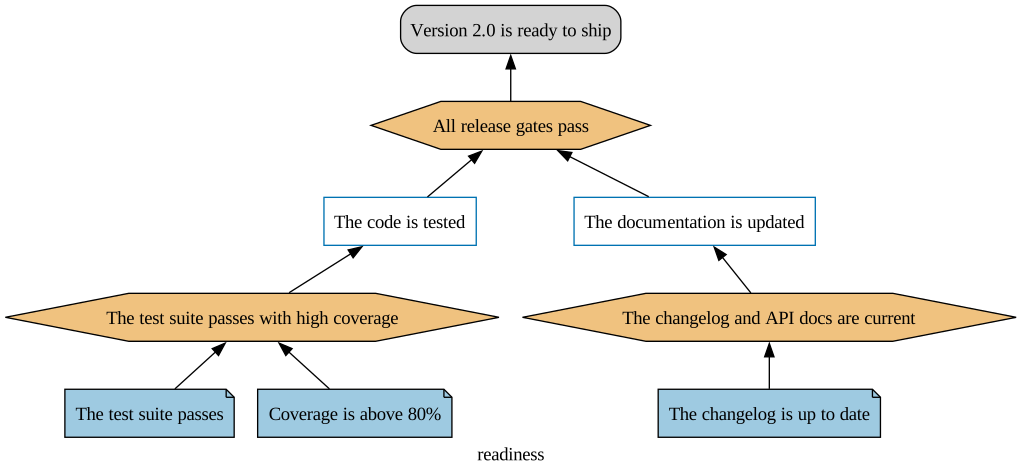
From a terminal, the same export is one command:
jpipe process -i readiness.jd -m readiness -f SVG -o readiness.svg
The shape of a valid argument
Now that the models are growing, a few rules are worth making explicit. They are what keep a justification well-formed, and what give its diagram that layered shape.
Every justification has exactly one conclusion. A conclusion is the single claim the whole
argument exists to establish, so a justification always requires one, and never more than one. A
model with no conclusion is incomplete; a model with two is really two arguments sharing a file.
Everything else hangs beneath that conclusion through support edges, and only certain edges are allowed:
- Evidence and sub-conclusions back strategies: a piece of
evidenceor asub-conclusioncan only support astrategy, never a conclusion directly. - Strategies back claims: a
strategysupports either the topconclusionor asub-conclusion.
Put together, every path runs from a piece of evidence, up through one or more strategies and sub-conclusions, to the single conclusion at the top:
| A… | can support a… |
|---|---|
evidence |
strategy |
sub-conclusion |
strategy |
strategy |
conclusion or sub-conclusion |
Where to next?
- Templates capture a reusable argument shape once and reapply it.
- Splitting models with
loadbreaks a large argument into per-concern files you can reuse and compose. - Make it executable binds each piece of evidence to a real check.
For larger, real-world models, see the jpipe-examples repository.